Saturday, June 25, 2011

For July: The Child Savers

UPDATE:
At a time when there is an ongoing and massive hunger strike by prisoners protesting conditions in isolation housing in California state prisons, this topic is very current.

Our meeting to discuss The Child Savers was fantastic. This book selection was a bit of a stretch for us- it was far more academic than the books we normally read. However, our book club members rose to the occasion, and we had a great conversation. Some issues that came up in the book were very familiar to us--it's amazing how history repeats itself sometimes-- including:

  • a tendency to idealize the past (the good old days, when kids grew up in the fresh country air)
  • a tendency to make assumptions about other people based on our own experiences and beliefs
  • an inherent danger in reform efforts in terms of unintended consequences
  • the long-term struggle of reform and the power of old institutionalized ways
  • the power of profiling based on race, class, and gender
  • the dissonance of competing ideas that seem to be inherent to incarceration: rehabilitation or punishment; improving character or reforming deviant behavior; protecting juveniles from bad environments or protecting society from criminals

We also found some very important questions coming up: when many people in society are afraid of criminals, and want them kept literally and figuratively on the fringes of society, people do not understand or empathize with criminals, and tend to think that incarcerated criminals 'get what they deserve' when incarcerated, and even assume that people "give up" their rights when the decide to break the law.

And finally: some really great solutions that came up during our discussion (and after):
1) change awareness about basic human rights (these are not changed or lost because of criminality): HRW points this out in their reports on prisoners all over the world: from Burma and Uganda to the USA's high level policies and practices.
2) talk to people, discover what they need and want (not what you think they need and want): HRW does this kind of work, since their researchers actually talk to prisoners in the process of writing their reports. Years ago, the LA WRC send members to interview inmates, and the ongoing review of LWOP surveys is another example.
3) help people find a good way out of cycles of poverty, crime, and violence: great examples are the literacy projects in which prisoners are encouraged to read, creatively express themselves, or earn a degree (sadly, these opportunities are generally lacking); vocational training in skilled, lucrative jobs such as welding or dog training.

Original Post:
For the summer, we are trying something a little new: this book is more academic in style than we usually read- but it is a classic: Rutgers University Press just came out with a 40th Anniversary Expanded Edition!
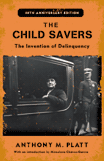
This is a book that has played a central role in juvenile justice debates in the US. It is also of particular interest to our group because the book approaches the question of juvenile delinquency by looking specifically at several women who played key roles in policy development; because the book itself influenced feminist history and feminist social policy; and because the subject matter of the book will bring us full-circle back to some of the themes of our last book, Girls Like Us. In our reading of Rachel Lloyd's powerful book, we were struck with the lack of support systems for the girls who were caught up in the law enforcement/juvenile justice/incarceration cycle. One of Rachel's key arguments is that these girls are not criminals- they should not be treated like women who break the law, because they are under the age of consent and they are often coerced, tricked, or even brutally forced to participate in the illegal sex industry. However, many law enforcement officials argue that the only thing they can do is to arrest these girls, because it is the only way to get them off the street. There are no social services or programs to support these girls, but jail is a place where the girls are safe from their pimps and can get off drugs (this in itself indicates some incredibly sad truths about the world that these girls live in). But there are serious problems with criminalizing the girls, as Rachel Lloyd points out: the whole world the girls live in needs to change, and punishing the girls is not going to help with that.

Reading about this world, about the challenges faced by these girls, and about the criminal behavior of the men who are pimps-- who are generally from the same neighborhoods, families, and socio-economic backgrounds as the girls are-- prompted us to ask a lot of questions about juvenile justice, about criminalization of adolescents' bad behavior, about how boys and girls experience poverty and violence differently, and about the history of juvenile justice in the US. We know that many young men (and some young women) are getting caught up in the adult prison system through life without parole (LWOP), mostly through the amazing work done on the issue by Elizabeth Calvin in the LA office of HRW. Reading this book will deepen our understanding of the issues.

Wednesday, April 13, 2011

May 11th: Girls Like Us

We have decided to read a book that is just about to be released (you can also get it on Kindle) by Rachel Lloyd. Her book Girls Like Us is about children who have experienced commercial sexual exploitation. The author is a survivor herself, and also an activist who founded an organization in NYC that helps girls recover from their experiences, and advocates for them in the criminal justice system.  

You do not have to read the book to attend. In fact, we may screen a film produced a few years ago by GEMS.

It looks as if Rachel will read from this book at Cries this year. We may also try to have Rachel come talk to us at a later date.

Tuesday, March 29, 2011

IntLawGrrls: Remembering Beijing: The Ferraro Factor

IntLawGrrls: Remembering Beijing: The Ferraro Factor

The author of this article was a guest speaker at the book club a while back- thanks to Ellen for this very interesting and inspiring article on Ferraro's contributions to international law on women's human rights!

Wednesday, March 9, 2011

April: Machete Season

Machete Season: The Killers in Rwanda Speak (2006) by Jean Hatzfeld, Susan Sontag and Linda Cloverdale.

For updates on human rights in Rwanda, see HRW's country page. The BBC has a good brief article on 'How the Genocide Happened'. I always find it interesting to look at the government's website as a useful introduction to the current issues in the country, and if you would like to go into more detail, I highly recommend that you check out Frontline coverage-- they have interviews, a chronology, political background, analysis, and more.

Susan Sontag's preface says that this book is one that  "everyone should read . . . [because making] the effort to understand what happened in Rwanda . . . is part of being a moral adult."

We will meet on Tuesday, April 12th to discuss the book.

Monday, February 7, 2011

And the World Changed, edited by Muneeza Shamsie

UPDATED!

Just broadcast! PBS Wideangle podcast on the Taliban and Women in Pakistan -- and how they are targeting women's rights and education. This is by the producer of Children of the Taliban.

100th International Women's Day
March 8th is International Women's Day, and we are celebrating in our own way: by reading an anthology of Pakistani women writers- stories set all around the world.

Interesting facts about Women's Day: in 1909, the Socialist Party of America declared the first National Women's Day, celebrated on February 28th. In 1910, leader of the Women's Office of the German Social Democratic Party Clara Zetkin called for an International Women's Day at the second International Conference of Working Women in Copenhagen. 100 women from 17 countries were in attendance. Austria, Denmark, Germany and Switzerland celebrated International Women's Day for the first time on March 25th, 1911. In 1913, Russia celebrated their first International Women's Day. In 1917, Russian women organized a strike, based on the 2 million Russian solders who died in the war, calling for 'bread and peace', and the movement ended up forcing the Czar to abdicate, and women got the right to vote!

HRW's Women's Rights Division
In honor of International Women's Day and as part of their 20th anniversary of the Women's Rights Division, HRW released a beautiful new webpage hub, which includes audio clips and a timeline:
Women's Rights Division

The following is the message that the WRD sent out on International Women's Day, 2011:
Today is the 100th anniversary of International Women’s Day and there is still much that we must do to ensure that women and girls can enjoy their human rights:
· Women still constitute the majority of those who are illiterate – two thirds of adults who cannot read and write are women, and this figure has not changed much over the last 20 years;
· Women workers continue to be clustered in the most insecure forms of work, including part time, casual and informal employment.  They earn less than men, and bear the burden of (largely) unpaid domestic work and childcare;
· Customary and statutory laws still limit women’s access to, and ownership of, land and other economic resources in Africa and Asia and consequently, women are over-represented amongst the poor;
· Violence against women, in its many manifestations, remains one of the most widespread and pervasive violations of human rights.

Despite this, there are many reasons to celebrate today and these include the establishment of UN Women (an achievement that represents several years of advocacy by women’s rights activists), women in the Middle East and North Africa taking their rightful places in demonstrations and protests to demand their human rights, the slow reduction of female genital mutilation, the increased numbers of women who are receiving ante natal care, and the diminishing gender gap in the enrollment of girls in primary education.  As Michele Bachelet said last Thursday night at the official launch of UN Women, “we have hope”.


Cries From the Heart, May 9th, 2011
Mark your calendars!
This is an evening of prose, poetry and performance at the Broad in Santa Monica.
For one night only, star performers will come together with Human Rights Watch, bringing to life the stories of Ordinary Heros. A cocktail reception precedes the performance, and a dessert and coffee reception concludes the evening.

We are seeking sponsors at levels from $1,000 - $10,000
Individual tickets are $100- $150

More information coming soon. Please start preparing a list of possible sponsors you could ask to support this important event!

And the World Changed
What a fantastic, passionate, committed group! We started out the evening talking about the new article posted by a fellow female journalist about CBS/60 minutes journalist Lara Logan, who experienced violent assault and rape while reporting on the protests in Tahrir Square, Egypt. Along with the well-written article in the New York Times (see the comments to this post), Amanda Marcotte's article for The Guardian provides a very clear summary and analysis, as well as a broadly representative set of links. Frustrating that women are still forced to make such difficult decisions about whether they should report gender-based violence on the job or just keep quiet, because if they speak up, they will face character assassination, claims that they 'asked for it', that they are lying for personal gain, and that men should do those jobs just to avoid such messy situations. This is an age-old dilemma, however, and one of many challenging, messy, murky life decisions that women often face. And this leads us to the discussion of the book! 

As an anthology, this book presented us with a very wide-reaching and complex view of Pakistani women's worlds. One theme that we came to notice was the complexity of women's responsibilities, allegiances, cultural and religious backgrounds, priorities and goals. Sometimes, when thinking about human rights work, it is easy to fall into a pretty black-and-white view of things: right and wrong, abuser and victim, justice and truth... but life is often not so obvious. Victims become aggressors; family members retain oppressive expectations along with providing abiding love and support; past violence continues to shape everyday meaning even for those who were not yet born when the conflict "ended"...

And the stories reminded us that the violence of colonial rule, and of Partition seem to be key elements of individual and familial identity, and daily life, even generations later. There were clear echoes in the claims of War is Not Over When It's Over . Also of the variety of women's lived experiences, the rich cultural, educational, political and artistic heritage of Pakistani women, of their global and cosmopolitan as well as parochial and conservative selves, of the importance of class and race in women's experience, and of how hard it was to generalize -- once we read these individuals' voices.

Recurring questions also arose: of the nature of the humanity of human rights abusers (how can they do such violence); of the utility and moral appropriateness of trying to understand why human rights abusers do what they do (how to explain and not excuse); of relativism and culture wars (HRW link); of impressing our ideas of what should be done or standing back; of how to define 'help' and 'solidarity' when we cannot understand the people we reach out to; and of idealism and anger at injustice, frustration with the intransigence of oppression, impatience with the slowness of change, and the danger of accepting people's suffering because we want to be understanding and patient. In other words, we got to the philosophical and ethical roots of human right work!

This anthology is available from the Feminist Press, as well as your more standard online booksellers, and comes highly recommended. Each author is introduced, and the 25 different stories cover a lot of topical ground. If you are interested in themes of social and cultural change, immigration, East-meets-West issues, and the challenging of stereotypes (gender, race, and class), you will be bound to find something here that is interesting.

In terms of background, we all know that Pakistan is important to the foreign policy of the U.S., particularly in the context of the ongoing violence in Iraq and Afghanistan. Pakistan is a nuclear power, and that makes it a really important player in the region. To take a look at the recent human rights issues in Pakistan, see HRW's website.

The BBC has a very useful and concise introduction to Pakistan.

Friday, January 14, 2011

Update for: It's Not Over

For those of you still interested in the very lively discussion we had on Ann Jones' book on women and war, the latest Tomgram includes an article by Ann Jones about Afghanistan, women's participation in politics, and the challenges of applying United Nations Security Council Resolution 1325. It is worth a read.

If you don't want to read, but you would like to listen.... you are in luck! An interview with Ann Jones is available.

Tuesday, December 21, 2010

First book of 2011: Nothing to Envy, by Barbara Demick

image of the Koreas from space
UPDATE:

An what a great conversation we had! The author's style of writing, based on the detailed research and clear prose of a newspaper reporter, combined with really engaging personal stories about everyday people in North Korea. To learn so many details about everyday lives in a country that is one of the most closed societies in the world was really fascinating. Most of us had no idea how bad the famine was, how advanced the North Koreans had been at the end of the Korean War, or how expansive government control really was.

One interesting question that came up in discussion was the question of how to understand this strange country, and the people who live in it. Were they all brainwashed? Based on the stories in the book, North Koreans are born and raised into a political system that is based on a cult of leader worship, and extensive monitoring. Every home is supposed to have framed photos of the leader and his father displayed. They have a special cloth to dust the photos with. Television, radio and film is all tightly controlled and censored, and listening to forbidden media would probably mean torture and the death penalty. The accepted position is that the leader of the nation is the provider of all that is good, that the North Koreans want for nothing and are better off than the rest of the world, and that they are a special people, the last communist society in a hostile world. However bad it is in North Korea, the rest of the world is to be pitied, since they are worse off and do not have such a great leader to protect and guide them. Even asking questions or expressing a small amount of skepticism about the government position can lead to a lengthy sentence in a labor camp.  Neighborhood monitors or unannounced police checks serve to enforce the rules.

How much personal choice and autonomy can you attribute to people who have been born and educated into such an all encompassing ideology? It is a very tricky question. We struggled to find comparisons in the rest of the world that would help us understand what was going on in North Korea. The fear of being spied on by a family member or neighbor, the danger of dissent, and the methods of social control were familiar to the strategies of other communist countries, for example in East Germany. The strategy of authoritarian leader worship is familiar not only in communist figures like Stalin (curiously enough, it is rising again), but also for example in countries like Syria, where people were subject to state propaganda that insisted that the President was infallible and all knowing. But scholars like Lisa Wedeen argue that people in Syria understand the strategies of the government, and have ways of expressing dissent. In North Korea, society is so closed that we simply have no idea whether there are spaces for such strategies to survive. Perhaps most of the people who have tried are in the massive labor camps, where the guilt of one (very small) transgression condemns an entire family to punishment. In a society where dissent can mean that your entire family, including children, are imprisoned and tortured, it is hard to imagine the coexistence of personal autonomy or dissent. But still, there are glimmers of it in Nothing Left to Envy.

There was much more to the conversation, but should be a good taste!
************

There really is very little information on North Korea, but this reporter conducted many interviews with people who left. The result is an amazing look inside this very secretive and closed society, with some historical reach and good factual information while also bringing us some detailed personal stories of people who left North Korea. They are stories of people who defected from their country, where they grew up believing that they had 'Nothing to Envy' in this world, but discovered the world had left their country behind.

North Korea has certainly been on the news recently, because of the recent South Korean military drill off Yonphyong Island and the North Korean military response of threats and return fire. Read the North Korean statements at this Wall Street Journal blog.

CNN's Wolf Blitzer recently went to North Korea with the Governor of New Mexico, Bill Richardson. They spent six days there. Their experiences are the official version of North Korea, and they saw the people in North Korea who are the counterweight to the people we will read about in Demick's book: the people Wolf Blitzer saw are the chosen, the well fed and clothed, the educated, the employed. Watch the video or read the short description of the trip here.

North Korea has also made the news recently because of signs that Kim Jong-il’s youngest son Kim Jong-un is his most likely successor. There are significant doubts, however, that the hand-over of power will go as planned. Of course, North Korea has proven experts wrong many times in the past. Regardless of the outcome, there are some serious human rights issues in this country, and the ramifications of the policies of the DPRK will haunt the region for a long time.