Friday, October 7, 2011

Nobel Peace Prize Awards

How exciting. There are three women this year who have been awarded the Nobel Peace Prize. Incredibly, the first woman to be awarded was Wangari Maathai, the environmental activist who did amazing work in Kenya. We just watched a film about her work, which won her the Peace Prize in 2004. The film makes powerful and effortless links between civic duty, participatory democracy, education, grassroots activism, community building, human health, environmental consciousness, human rights, and women's participation at all levels of society. Wangari Maathai, who recently passed away, fought hard and long and wisely for environmental justice.

These women follow in this tradition, fighting peacefully and powerfully for human rights: the first woman elected to the presidency in Africa (Ellen Johnson Sirleaf), the leader of the interfaith women's peace activism that brought an end to civil war in Liberia (Leymah Gbowee), and a pro-democracy activist in Yemen (Tawakul Karman), are the first women to be awarded the prize since it was awarded to Maathai in 2004.

The book club has touched on the work of all of these women except Karman. Human Rights Watch reminds us that the work is not over, and that with the Prize, more dangerous and important work awaits. Here's to the possibility of more women being recognized across the world for their incredible work for peace by taking on important challenges in human rights, justice, women's equality, democracy, health, the environment, education, conflict resolution, the arts... and more.

Wednesday, August 31, 2011

First Ever Film Night

We watched Taking Root, and the film was really great. It covered so many topics, and was entertaining and inspiring as well. A full review will be be written up and posted here in several days, but just to give you an idea- this film is about a woman who grew up in rural Kenya, became the first East African woman to earn a PhD, became a professor, and chair of her department. She started the Green Belt Movement, encouraging women to plant trees to fight deforestation, soil erosion, food scarcity and fuel scarcity. This simple idea turned into a platform for the formation of women's groups all over the country, which supported confidence, community, democratic practices, civic participation, environmental protection and restoration, political protest, and much more.

Next we will try something else new: author Kwame Anthony Appiah is a philosopher well known for his writing on cosmopolitanism, and his new book is about how the sense of honor plays into what he calls "moral revolutions", in which an ongoing cultural practice shifts from being acceptable to unacceptable.

More soon!

Wednesday, July 6, 2011

In the News: Women in Somalia

Remember when we read the book by Ann Jones, called War is Not Over When It's Over ? I remember how intense it was to read the accounts of how women were surviving the wars that are fought after open hostilities have officially ended.

We decided to put another book on hold, because it was in many ways very similar: A Thousand Sisters, by Lisa Shannon. The book is the story of one woman awakening to the massive problem of rape and other violence in Congo, and deciding to do something about it. One of our book club members had decided to intern for the summer at Women for Women International, the same organization that Lisa Shannon turned to when she decided to do something to help women in Congo (and, by the way, the Zainab Salbi, founder of Women for Women also has a memoir that is on our list, and she also has an amazing story).

Well, Lisa Shannon is starting to work in Somalia, and she is already getting the word out-- this PRI story came out this week: Rape Hotline Reaches out to Women in Somalia, and you can read more about the project, which is a partnership with a number of other groups, on the Thousand Sisters blog.

Saturday, June 25, 2011

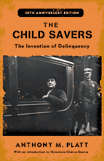
For July: The Child Savers

UPDATE:
At a time when there is an ongoing and massive hunger strike by prisoners protesting conditions in isolation housing in California state prisons, this topic is very current.

Our meeting to discuss The Child Savers was fantastic. This book selection was a bit of a stretch for us- it was far more academic than the books we normally read. However, our book club members rose to the occasion, and we had a great conversation. Some issues that came up in the book were very familiar to us--it's amazing how history repeats itself sometimes-- including:

  • a tendency to idealize the past (the good old days, when kids grew up in the fresh country air)
  • a tendency to make assumptions about other people based on our own experiences and beliefs
  • an inherent danger in reform efforts in terms of unintended consequences
  • the long-term struggle of reform and the power of old institutionalized ways
  • the power of profiling based on race, class, and gender
  • the dissonance of competing ideas that seem to be inherent to incarceration: rehabilitation or punishment; improving character or reforming deviant behavior; protecting juveniles from bad environments or protecting society from criminals

We also found some very important questions coming up: when many people in society are afraid of criminals, and want them kept literally and figuratively on the fringes of society, people do not understand or empathize with criminals, and tend to think that incarcerated criminals 'get what they deserve' when incarcerated, and even assume that people "give up" their rights when the decide to break the law.

And finally: some really great solutions that came up during our discussion (and after):
1) change awareness about basic human rights (these are not changed or lost because of criminality): HRW points this out in their reports on prisoners all over the world: from Burma and Uganda to the USA's high level policies and practices.
2) talk to people, discover what they need and want (not what you think they need and want): HRW does this kind of work, since their researchers actually talk to prisoners in the process of writing their reports. Years ago, the LA WRC send members to interview inmates, and the ongoing review of LWOP surveys is another example.
3) help people find a good way out of cycles of poverty, crime, and violence: great examples are the literacy projects in which prisoners are encouraged to read, creatively express themselves, or earn a degree (sadly, these opportunities are generally lacking); vocational training in skilled, lucrative jobs such as welding or dog training.

Original Post:
For the summer, we are trying something a little new: this book is more academic in style than we usually read- but it is a classic: Rutgers University Press just came out with a 40th Anniversary Expanded Edition!

This is a book that has played a central role in juvenile justice debates in the US. It is also of particular interest to our group because the book approaches the question of juvenile delinquency by looking specifically at several women who played key roles in policy development; because the book itself influenced feminist history and feminist social policy; and because the subject matter of the book will bring us full-circle back to some of the themes of our last book, Girls Like Us. In our reading of Rachel Lloyd's powerful book, we were struck with the lack of support systems for the girls who were caught up in the law enforcement/juvenile justice/incarceration cycle. One of Rachel's key arguments is that these girls are not criminals- they should not be treated like women who break the law, because they are under the age of consent and they are often coerced, tricked, or even brutally forced to participate in the illegal sex industry. However, many law enforcement officials argue that the only thing they can do is to arrest these girls, because it is the only way to get them off the street. There are no social services or programs to support these girls, but jail is a place where the girls are safe from their pimps and can get off drugs (this in itself indicates some incredibly sad truths about the world that these girls live in). But there are serious problems with criminalizing the girls, as Rachel Lloyd points out: the whole world the girls live in needs to change, and punishing the girls is not going to help with that.

Reading about this world, about the challenges faced by these girls, and about the criminal behavior of the men who are pimps-- who are generally from the same neighborhoods, families, and socio-economic backgrounds as the girls are-- prompted us to ask a lot of questions about juvenile justice, about criminalization of adolescents' bad behavior, about how boys and girls experience poverty and violence differently, and about the history of juvenile justice in the US. We know that many young men (and some young women) are getting caught up in the adult prison system through life without parole (LWOP), mostly through the amazing work done on the issue by Elizabeth Calvin in the LA office of HRW. Reading this book will deepen our understanding of the issues.

Wednesday, April 13, 2011

May 11th: Girls Like Us

We have decided to read a book that is just about to be released (you can also get it on Kindle) by Rachel Lloyd. Her book Girls Like Us is about children who have experienced commercial sexual exploitation. The author is a survivor herself, and also an activist who founded an organization in NYC that helps girls recover from their experiences, and advocates for them in the criminal justice system.  

You do not have to read the book to attend. In fact, we may screen a film produced a few years ago by GEMS.

It looks as if Rachel will read from this book at Cries this year. We may also try to have Rachel come talk to us at a later date.

Tuesday, March 29, 2011

IntLawGrrls: Remembering Beijing: The Ferraro Factor

IntLawGrrls: Remembering Beijing: The Ferraro Factor

The author of this article was a guest speaker at the book club a while back- thanks to Ellen for this very interesting and inspiring article on Ferraro's contributions to international law on women's human rights!

Wednesday, March 9, 2011

April: Machete Season

Machete Season: The Killers in Rwanda Speak (2006) by Jean Hatzfeld, Susan Sontag and Linda Cloverdale.

For updates on human rights in Rwanda, see HRW's country page. The BBC has a good brief article on 'How the Genocide Happened'. I always find it interesting to look at the government's website as a useful introduction to the current issues in the country, and if you would like to go into more detail, I highly recommend that you check out Frontline coverage-- they have interviews, a chronology, political background, analysis, and more.

Susan Sontag's preface says that this book is one that  "everyone should read . . . [because making] the effort to understand what happened in Rwanda . . . is part of being a moral adult."

We will meet on Tuesday, April 12th to discuss the book.